Commemorating the Dead & Interpreting Traumatic Pasts - 1190 & HMD

PLAQUE COMMEMORATING THE 1190 MASSACRE INSTALLED BY JEWISH HISTORICAL SOCIETY
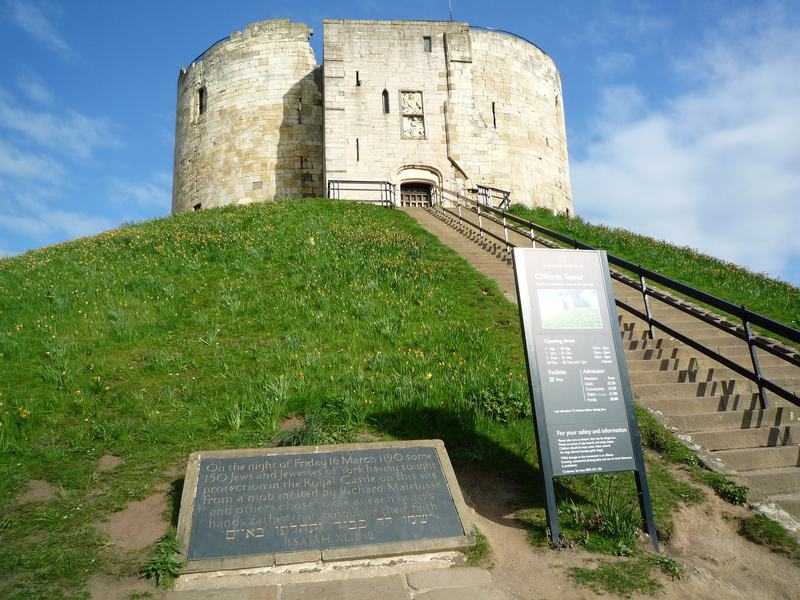
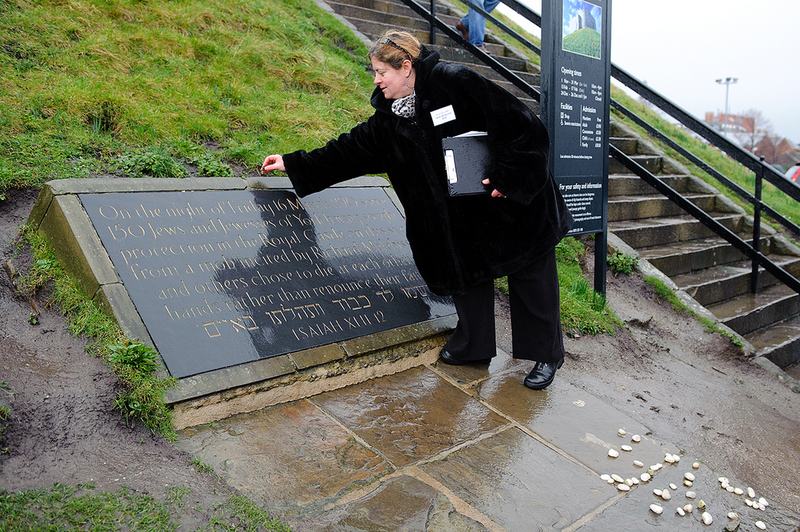
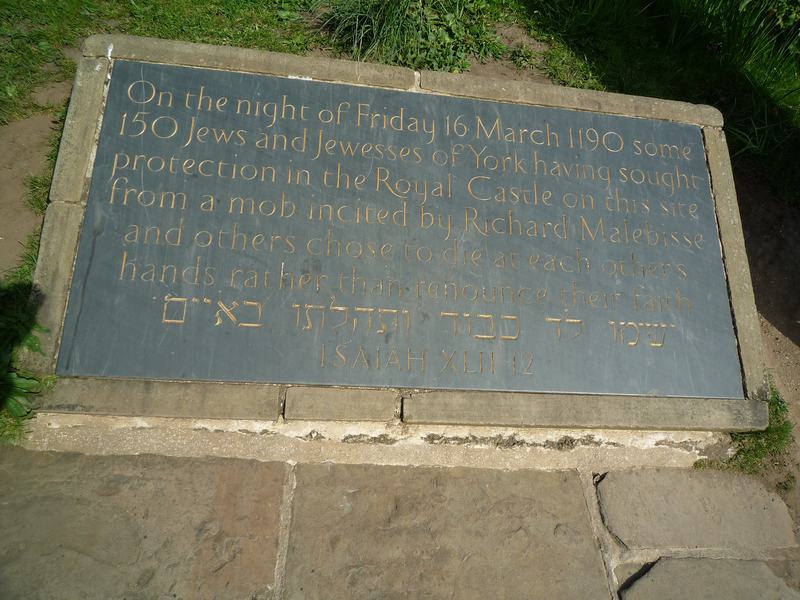
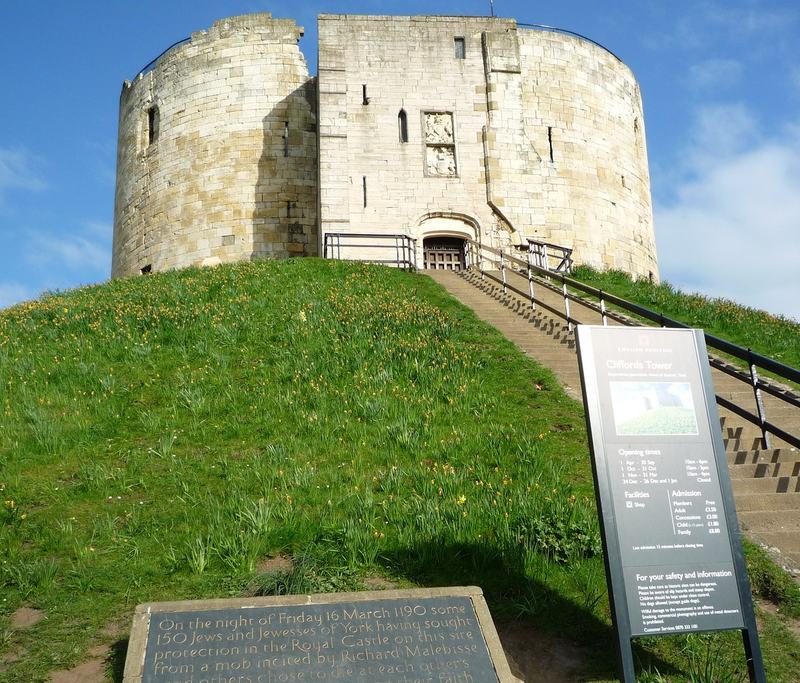
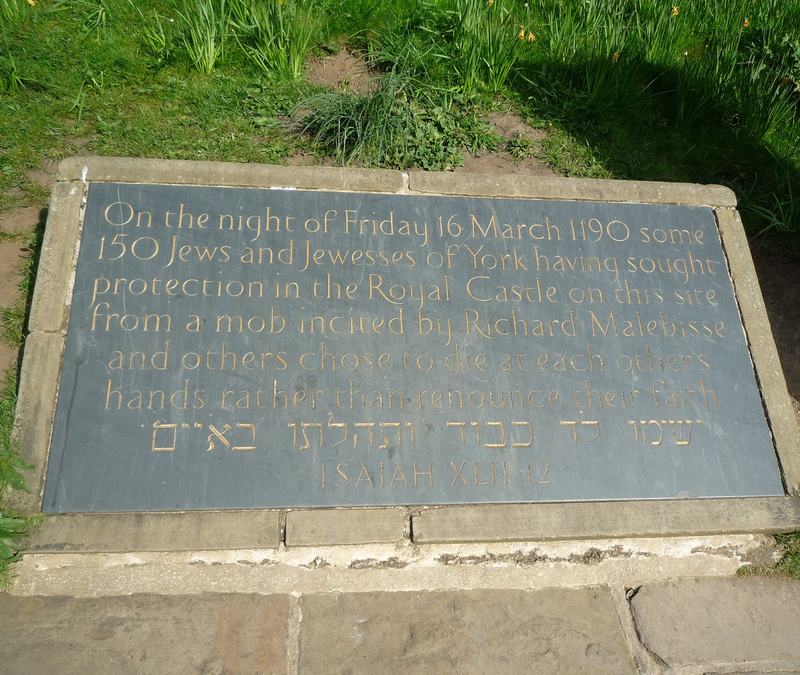
There is a prominent plaque acknowledging the massacre of Shabbat HaGadol when almost every member of York's Jewish Community perished in 1190. Shabbat haGadol means the Great Sabbath and has particular significance in the Jewish calendar because it is the Shabbat which precedes Passover. The plaque commemorating the tragedy is situated at the base of the Clifford's Tower in York which is a commemorative marker rather than a piece of interpretation. It was installed after a prolonged campaign by the Jewish Historical Society of England.
The plaque text is chisseled in granite and is situated to the left of the staircase up to the Tower: "On the night of Friday 16 March 1190 some 150 Jews and Jewesses of York having sought protection in the Royal Castle on this site from a mob incited by Richard Malebisse and others chose to die at each others hands rather than rencounce their faith HEBREW ISAIAH XLII IV
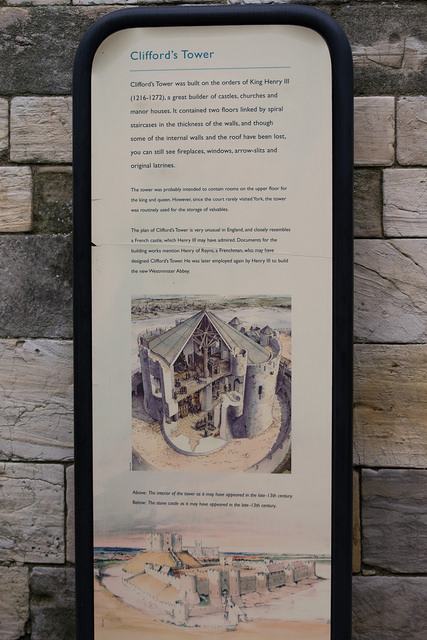
English Heritage does not mention the 1190 massacre on the website entry for Clifford's Tower. And there is just one interpretation panel of 250 words within summarizing how the Jewish community came to die whilst under royal protection when the Castle was laid under siege and set fire by a mob on 16th March 1190. This lack of interpretation contrasts to the three commemorative markings visible at Clifford's Tower every year.
THE REBUILDING OF A TOWER IN TIMBER FOLLOWED BY STONE STRUCTURE IN THE 13th CENTURY
The paragraphs below will describe the building and rebuilding of the Tower, give an overview of English Heritage's previous interpretation strategy, and describe the three ongoing commemorative markers at Clifford's Tower to the traumatic history of Jewish pogroms. Please note that this is an overview of how it has come to be that the tragedy of 1190 is more commemorated than interpreted around the site at York Castle.

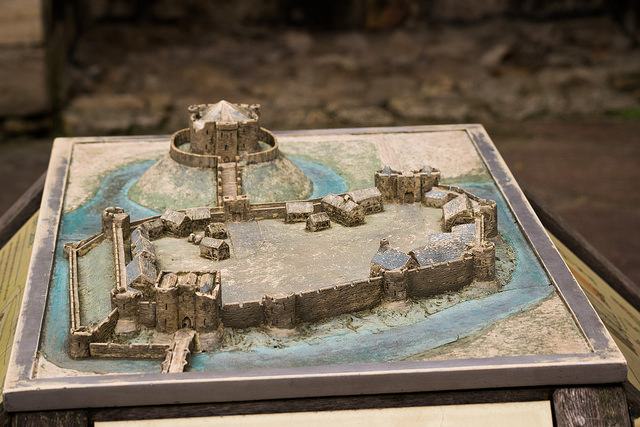
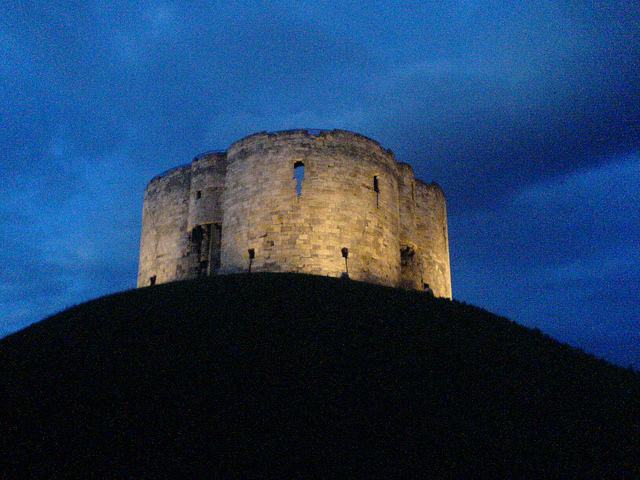
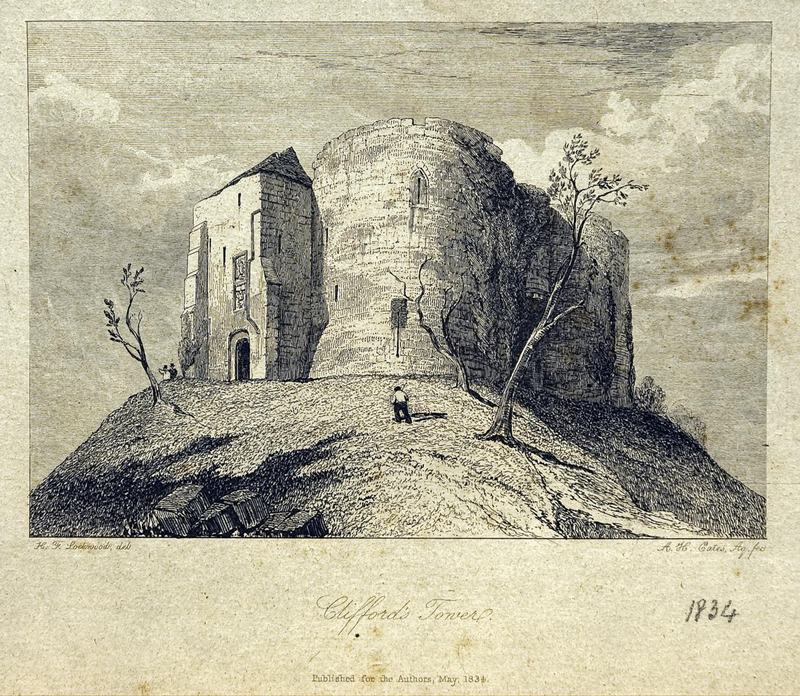
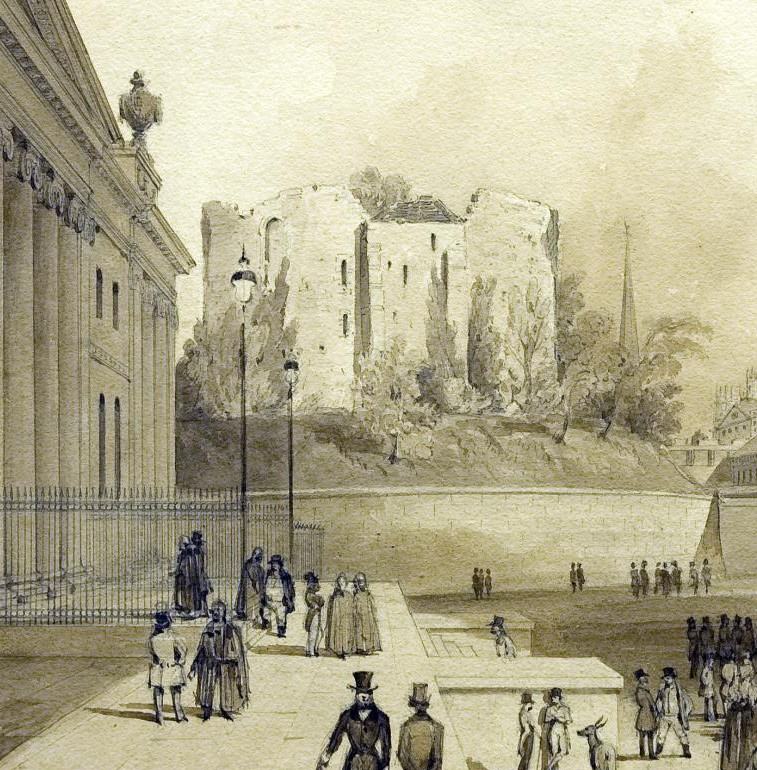
Originally a timber construction built after the Norman Conquest, much of that first building was destroyed in 1069 during a skirmish when the Castle was attacked by Danish invaders. Rebuilt swiflty for defense purposes by the Normans, the timber structure was again destroyed 130 years later in 1190 during riots which led to the massacre of most of York's Jewish population. A timber tower structure was again built for the royal administration in York, but destroyed in a bad storm documented to have occurred in 1228.
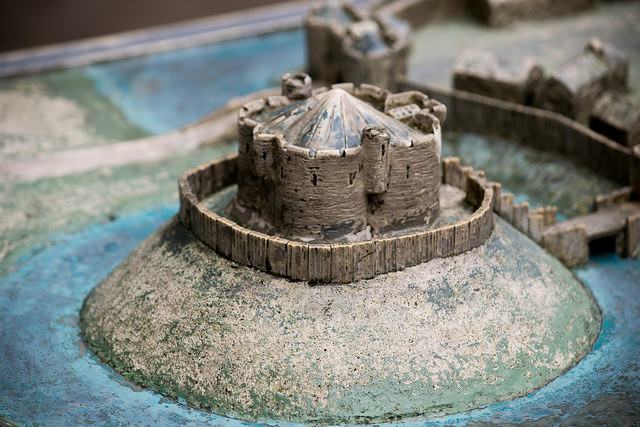
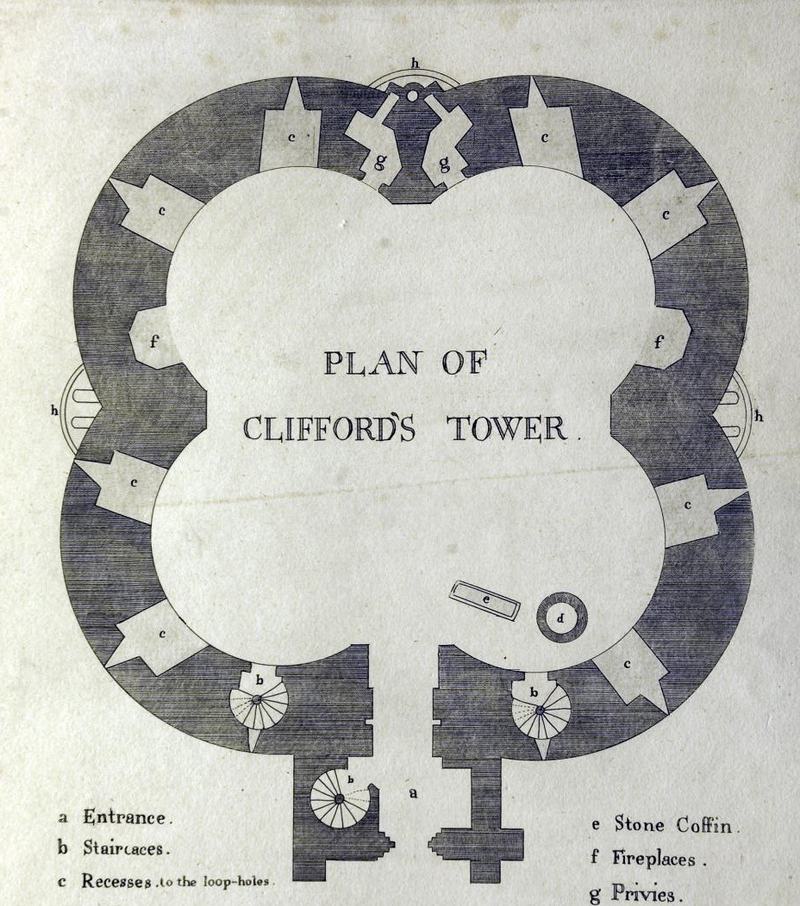
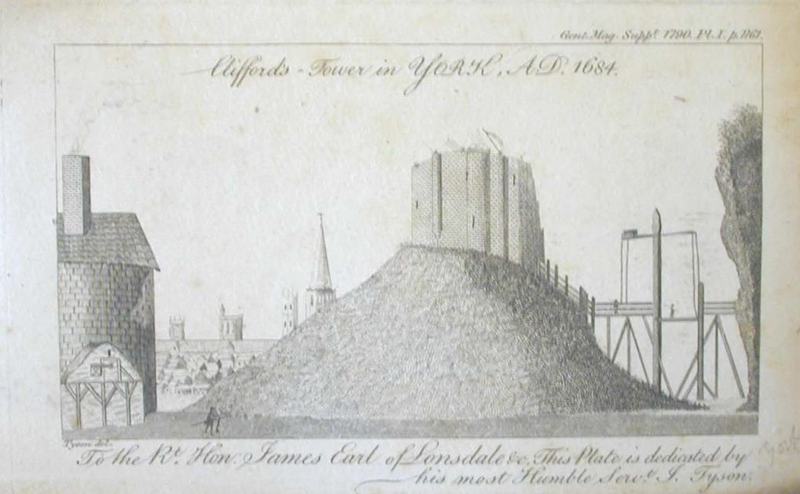
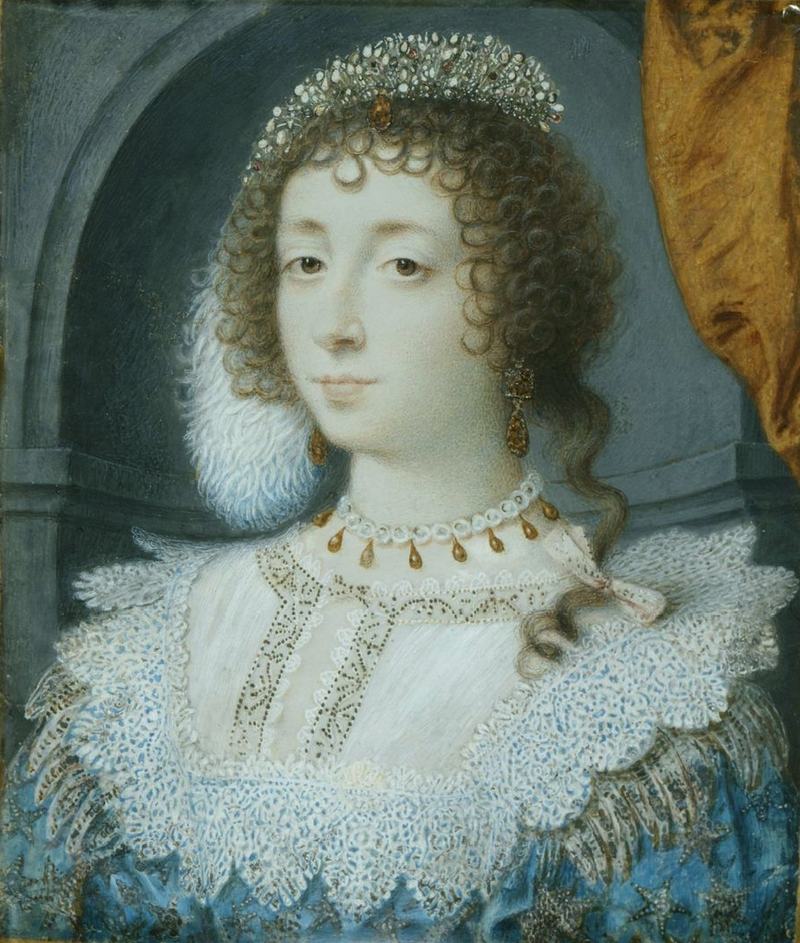
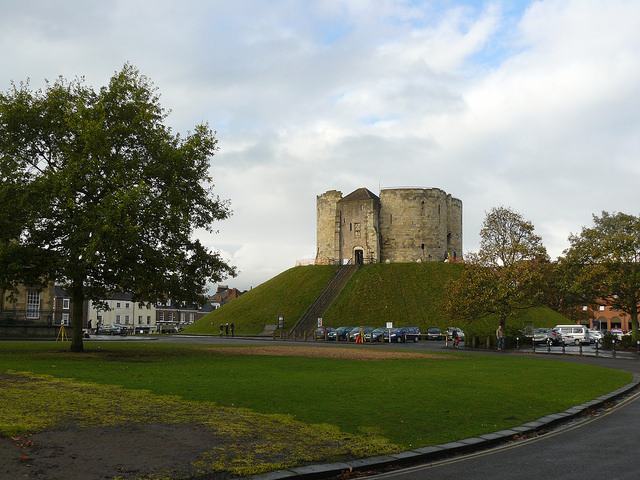
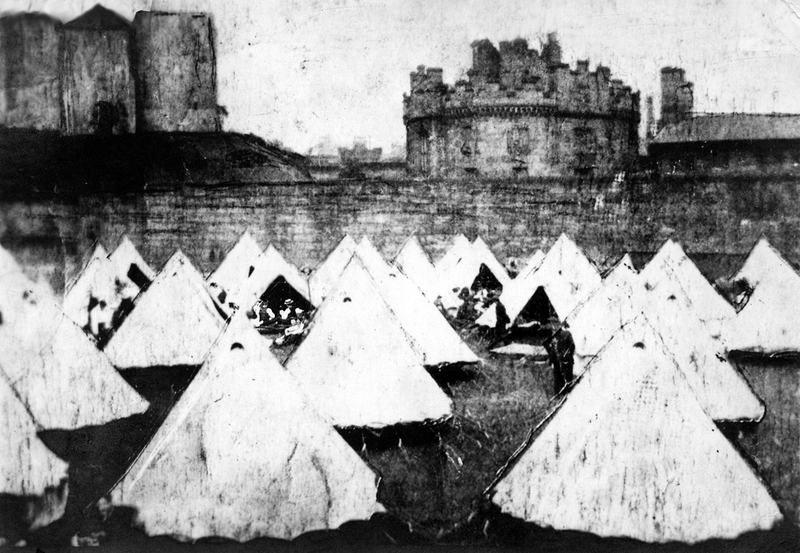
The motte has since changed shape, with earth and rubble and concrete and stones added to the base, and what is visible today is the 13th century construction built probably about 15 to 20 foot above the position of the 1190 destroyed timber tower. The stone structure served numerous functions including a treasury for the royal administration, and was extensively renovated and furnished in the 1640s by Henrietta Maria to be used as a royal residence in times of strife during the civil war. The building survived the civil war, but an alleged accidental explosion forty years later in 1684 left only its shell surviving to the present day.
INTERPRETATION STRATEGY OF ENGLISH HERITAGE AT CLIFFORD'S TOWER
Insights about the interpretation strategy of English Heritage were delivered by David Thomas, Interpretation Officer at English Heritage on Monday 28th February 2011 invited by Helen Weinstein to discuss the problems of interpreting and presenting the history of Clifford's Tower in York, and especially the massacre of Jews on the site in 1190. The notes below have been published on this website in 2014 to give an overview of the discussion, to help inform a way forward for a re-presentation of Clifford's Tower.
David Thomas briefly described his own work as an Interpretation Officer for English Heritage, overseeing the presentation and interpretation at over 100 English Heritage sites in his care across the north of England. The sites vary tremendously, from a small section of Hadrian's Wall with a single sign to a large site such as Whitby Abbey, with a visitor centre with multimedia shows and publications. English Heritage's mission is to encourage the public to value the sites, to understand their historic significance, to enjoy them, and to care for them.

The massacre of the Jews in 1190 is, in the language of the English Heritage guidebook for the site, "the most notorious event” related to Clifford’s Tower. How does English Heritage interpret and present such a traumatic history? David first explained how interpretative work is conducted at English Heritage. It is a team delivery, which facilitates a multidisciplinary and collaborative approach, involving curators, conservators, historians, educational specialists, and marketing departments. The work takes into account the uniqueness of each site; each place is looked at in detail and its architecture, heritage, and historical significance are all considered. Fashion in interpretative work changes: for example, the history of women is much more prominent than it used to be, as well as that of the disabled and marginalised groups. Most recently a focused project at English Heritage has been researching properties’ connections with the profits from the enslavement of Africans and investments in the transatlantic slave trade up to the Abolition Act of 1807.


The interpretation team has a crucial focus on its audiences and considers what it is that visitors might want to know. At some sites English Heritage works closely with local communities and stakeholders. The physicality of the sites must also be considered, as this influences what kinds of media can be used. Finally, the marketing is not normally based on a single event or theme, but is designed to make a wide ranging offer for visitors, especially with a focus on the family market. In the case of Clifford’s Tower it is important to English Heritage not to sensationalise the history of the massacre of the Jews. In cases of what may be considered as ‘traumatic history’, such as the York massacre of 1190, care is taken to present more than one viewpoint and thus to include different voices and perspectives. At present, David admitted, this is under developed at the site; however at the same time English Heritage has to acknowledge that Clifford’s Tower has a long history stretching back to the Norman Conquest and therefore it is important to introduce this time depth. The site also receives very high visitor numbers, more than 140,000 per annum, and it is recognised that many of these visitors come for the view of the city from the top of the tower and are therefore not spending a long time on their visit. Any interpretation has to therefore grab their attention and encourage a longer dwell time, whilst also recognising that the site is small and could easily become overcrowded.

INTERPRETATION OF THE 1190 MASSACRE BY ENGLISH HERITAGE AT THE SITE OF CLIFFORD'S TOWER
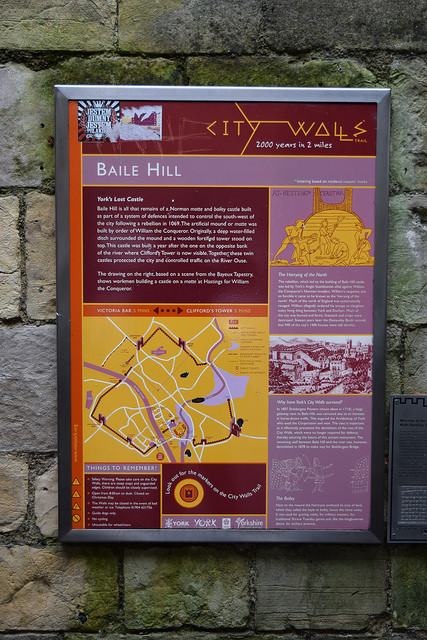
So how is the 1190 massacre interpreted at Clifford’s Tower today? First of all, said David Thomas, it is not particularly prominent. It is not mentioned at all on the webpage, which mainly presents the physical history of the site and its architecture. At the site of the tower itself, the massacre is described on one of the graphic panels. Text concerning the massacre only takes up six lines on the panel, but since there are only three such panels of approximately 250 words each, this amount may be sufficient if the history of the massacre is not to be overemphasised within the long history of the site. The English Heritage 2010 guidebook to Clifford’s Tower, a forty-page publication, holds a two-page description of the massacre and an additional page explaining the background.
This is much more than was offered by English Heritage in the past. The 1987 guidebook held very little detail of the massacre and only dedicated six lines to describing it. The 1997 guidebook had two pages on the history of the Jews of medieval York more generally, describing the massacre in 1190 along with other things. In comparison, the already mentioned 2010 guidebook has two pages focusing on the events in 1190 alone, so clearly there is an increasing focus on the history of the massacre. In the future English Heritage may want to do more, possibly with guided tours. But, David stated that ‘first-person’ tours, re-enactment-style events or ghost tours concerning the events of 1190 are not likely to take place, as it is necessary to respect the sensitivity of the subject and the site.
COMMEMORATIVE PLAQUE & ACTIVITIES OF JEWISH GROUPS IN UK AND USA
Interestingly, it seems that the history of the massacre is actually more commemorated than interpreted. Most obviously there is the plaque at the foot of the steps leading up the Tower, which was installed after a prolonged campaign by the Jewish Historical Society. Before 1978 the Ministry of Works, the forerunner of English Heritage, who administered the site, did not allow commemorative signage. English Heritage, in contrast, has been open to commemorative activities by the Jewish community locally, nationally and internationally. The plaque laid by the Jewish Historical Society was part of an act of reconciliation between communities and was part of a ceremony led by the Chief Rabbi and the Archbishop of York.

COMMEMORATIVE DAFFODILS REPRESENTING STAR OF DAVID TO BLOOM ON 16TH MARCH
The commemorative marking that is most visible to residents and visitors is the striking special daffodils that bloom over the mound in March every year to mark the massacre. This planting came about as a result of a three-day commemorative event in 1990, and in the early 1990s, in a co-operative venture between English Heritage and the American Jewish Foundation, six-leafed daffodils were planted all over the grassy mound surrounding Clifford’s Tower.
This type of flower was selected to signal a connection to the Star of David, and because they bloom early, in mid-March, near the date of the massacre, which was on the 16th of March 1190. However, because the commemorative daffodil significance is not acknowledged or publicised at the site or online at English Heritage, this symbolism is not widely known.
ENGLISH HERITAGE WEBSITE FEATURES THE DAFFODILS BUT AVOIDS THE JEWISH TRAGEDY
Indeed, the English Heritage webpage for Clifford's Tower prominently shows the mound with the flowering daffodils, but the text refers to the site in the context of royal power and as a scenic tourist attraction for viewing York today:
http://www.english-heritage.org.uk/daysout/properties/cliffords-tower-york/
"The stunning panoramic views from the top of Clifford’s Tower, out over the historic city of York, makes it one of the most popular attractions in Yorkshire. Set on a tall mound in the heart of Old York, this imposing tower is almost all that remains of York Castle, which was originally built by William the Conqueror. There’s plenty to discover here. In its time, the tower has served as a prison and a royal mint, as well as the place where Henry VIII had the bodies of his enemies put on public display."
INTERPRETATION & MARKETING OF CLIFFORD'S TOWER BY ENGLISH HERITAGE
Thus, there remains, perhaps, an unresolved tension between the interpretation and marketing of Clifford’s Tower, which broadly focuses on medieval architecture and royal power and life in the castle, and the interpretation and presentation of the massacre in 1190. The latter is still not very visible at the monument, and although English Heritage has supported the annual commemorative event and Kaddish for the dead recited by a member of the Jewish community to mark Holocaust Memorial Day organised by York City Council at the base of Clifford’s Tower, perhaps English Heritage as a heritage organisation needs to take responsibility for communicating 1190 more comprehensively: the narrative, its meaning, and its commemoration.
Holocaust Memorial Day 2015: Tuesday 27th January
Each Year on 27 January on Holocaust Memorial Day (HMD) people across the world remember all those whose lives were destroyed in the Holocaust and the countless lives lost through other genocides and persecutions around the world.
The programme of events are held on and around the 27th January to commemorate the liberation of the Auschwitz-Birkenau concentration and death camp in January 1945. HMD has been held in the UK since 2001 and the City of York has been marking this occasion since 2008.
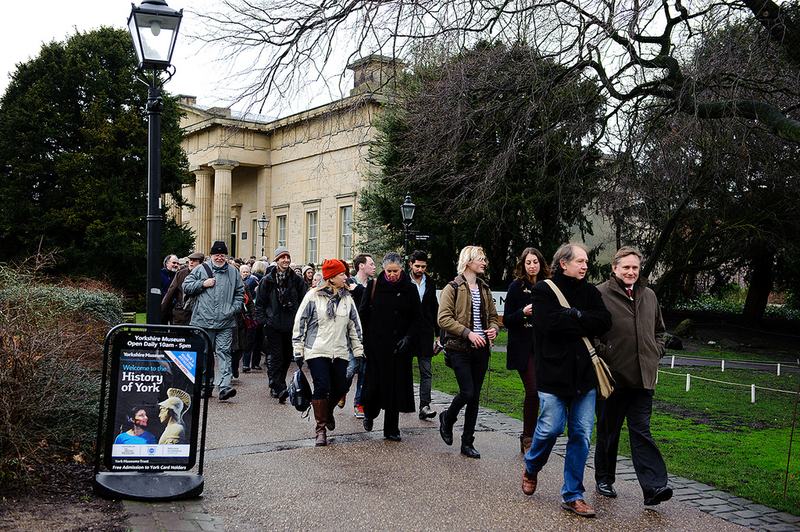
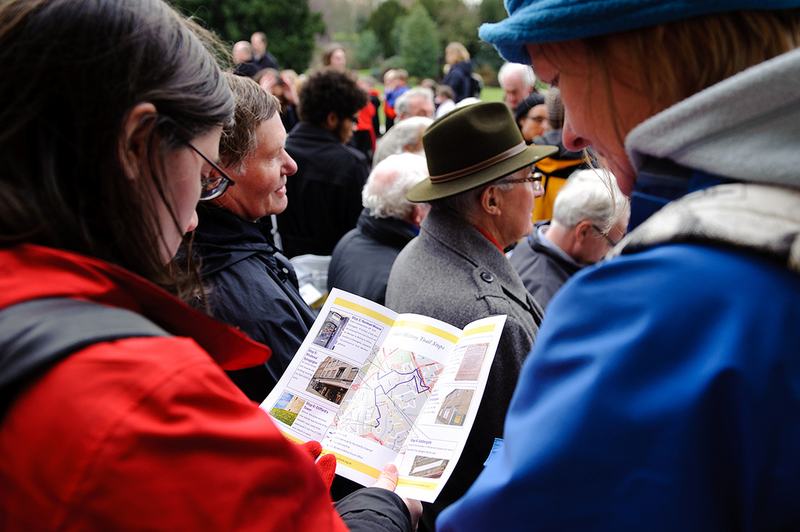
On the invitation of York City Council there has been a marking of 1190 as part of the Holocaust Memorial Day programme by requesting Helen Weinstein to lead a Jewish History trail ending at the site of the massacre at Clifford's Tower. It is perhaps fitting to mark HMD at Clifford's Tower because it is the site of a traumatic past where a community was massacred because of their ethnicity.
English Heritage has kindly opened Clifford's Tower for Helen Weinstein to discuss the Jewish history of York with interested members of the public as part of the civic programme as an act of engaging with and understanding the past. Many hundreds have attended these discussions, mostly residents of the city, wanting to know more about their Jewish neighbours past and present. However it has always helped that elders of the Jewish community from York, Leeds, Knaresborough, Selby, Halifax, Scarborough and Middlesborough have attended the Jewish History trail too, to discuss the lives of Jews in Yorkshire from the Norman times to the present day.
Also, the committee for HMD in York always ensure that it is not only Jewish pogroms that are remembered. On HMD 2015 it will be 70 years since the liberation of Auschwitz-Birkenau. 2015 will also be the 20th anniversary of the Genocide in Srebrenica, Bosnia. Therefore it is particularly appropriate that the theme for this major anniversary year focuses on memory. All those persecuted around the world will be remembered. See more at: http://hmd.org.uk/resources/theme-papers/hmd-2015-keep-memory-alive#sthash.tuUzLGsV.dpuf.
York’s HMD programme enables those living, working and visiting the city to come together to reflect individually and collectively, to learn the lessons of the past and seek to create a safer, better future. It is believed that in remembering and acknowledging the past we can each help to promote a more tolerant and inclusive society for the future.
Recommended Reading on traumatic pasts:
- LaCapra, D. 2004 History in Transit: Experience, Identity, Critical Theory (Ithaca), 106-144
- Logan, W. & K. Reeves (eds.) 2009 Places of pain and shame: dealing with 'difficult heritage' (London)
- Pickering, P. & Tyrell, A. (eds.) 2004 Contested Sites: Commemoration, Memorial and Popular Politics in Nineteenth Century Britain (Aldershot)